
Dev Log: Trading
As we prepare to release Elysian, I think it’s time to discuss the most important new element you will deal with:
Economy & Trade
As a recap, in the previous season, our economic model was pretty primitive. It was centered around NPC traders with fixed locations and fixed prices, with a dollar-based currency pulled from thin air. This system, believe it or not, was already superior to economic systems most other SMP style servers use. However, for this launch, we have been working on a brand new system.
This new system is realistic and complicated. It will increase the level of skill needed to run a Nation/Town and will likely increase player-to-player trade. In this Dev Log, I won’t go into all the details; for that, there will be a separate Doc that walks through all the features.
In "Short":
The new Elysian economic system is based on the Gold standard. Currency that you can use will need to be made from gold extracted from the world. For now, we have settled on a simple conversion system: 4 Gold ingots => 50 Gold Units (Gu). This isn’t perfect, as in the process of obtaining Gu, you melt down gold ingots, which causes some loss. So, for example, if you are unlucky, instead of 50 Gu, you might only get 40 Gu at the end of the whole process. Normally speaking, this would only be a last resort to obtain Gu, only needed early-game.
The purpose of currency remains the same as it did in the past. It's still needed for upkeep and is perfect for trade.
Previously, in order to trade your Goods for currency, you needed to travel to a Shop NPC somewhere on the map. This caused several issues, possibly including almost causing a new Nation to get obliterated because they were unaware that one of the NPC Merchants was located within their new claims (caugh, Clementia).
Economy & Trade
As a recap, in the previous season, our economic model was pretty primitive. It was centered around NPC traders with fixed locations and fixed prices, with a dollar-based currency pulled from thin air. This system, believe it or not, was already superior to economic systems most other SMP style servers use. However, for this launch, we have been working on a brand new system.
This new system is realistic and complicated. It will increase the level of skill needed to run a Nation/Town and will likely increase player-to-player trade. In this Dev Log, I won’t go into all the details; for that, there will be a separate Doc that walks through all the features.
In "Short":
The new Elysian economic system is based on the Gold standard. Currency that you can use will need to be made from gold extracted from the world. For now, we have settled on a simple conversion system: 4 Gold ingots => 50 Gold Units (Gu). This isn’t perfect, as in the process of obtaining Gu, you melt down gold ingots, which causes some loss. So, for example, if you are unlucky, instead of 50 Gu, you might only get 40 Gu at the end of the whole process. Normally speaking, this would only be a last resort to obtain Gu, only needed early-game.
The purpose of currency remains the same as it did in the past. It's still needed for upkeep and is perfect for trade.
Previously, in order to trade your Goods for currency, you needed to travel to a Shop NPC somewhere on the map. This caused several issues, possibly including almost causing a new Nation to get obliterated because they were unaware that one of the NPC Merchants was located within their new claims (caugh, Clementia).
We are happy to announce there will no longer be any location-based Shop NPC’s anywhere, and trading will be fully custom.
So how will trading work?
Well, there is bad news and good news. The good news is, nobody will need to cross the map again to trade with an NPC located on the other side of the map. The bad news is, it’s now complicated.
Trading will work via a “Trading Station”. This is a new functional block that you will use to direct your trades. You can place it anywhere*, so that means you can run your business directly from your Town.
*Anywhere means anywhere on mainland Elysian. We have decided not to allow Ocean outposts or similar for trading. You will understand why later in this doc.

The Trading Station block.
In order to properly set up your new Trading Station, you will need to construct a proper dock with a deep berth and connect some storage crates to the Station. Connecting them is easy: nobody has used these crate blocks before, so any crate block in close proximity to the Trading Station is automatically connected.
Via the Trading Station, you can sell goods, buy goods, and ship goods (assuming it’s worth it). You can fulfill these abilities via the crates you connected; you store the goods you want to transport, and any goods you buy will arrive in these crates. You will be able to trade with both other players and also new foreign NPC nations. These NPC nations are not located on Elysian, but are real existing nations, like Portugal or the Ottoman Empire (nations relevant to trade around the 1800s).
Via the Trading Station, you can sell goods, buy goods, and ship goods (assuming it’s worth it). You can fulfill these abilities via the crates you connected; you store the goods you want to transport, and any goods you buy will arrive in these crates. You will be able to trade with both other players and also new foreign NPC nations. These NPC nations are not located on Elysian, but are real existing nations, like Portugal or the Ottoman Empire (nations relevant to trade around the 1800s).
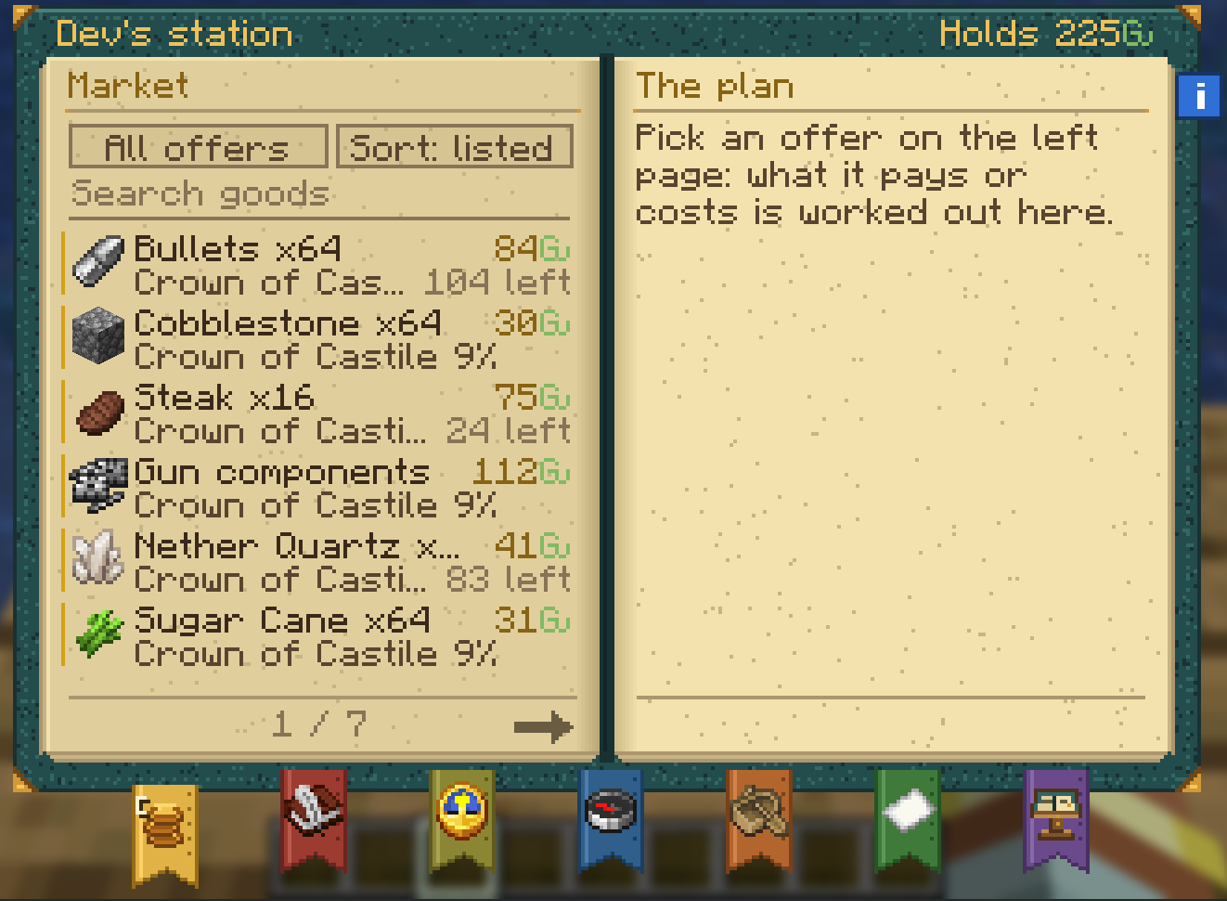
The Trading Stations Market page. (Yes, guns are coming)
We won't go through all the pages here, but the trading station has 7 ribbons (pages) visible at the bottom. In order from left to right: Market, Orders, Prices, Voyages, Fleet, News, and Station. Some of these are only informational, or for settings.
Goods move around via actual Ships. These ships are sailed by the Merchant NPCs, so you don’t need to drive the ships yourself. However, they are still real ships that need to move around. This is very important because they need proper infrastructure and planning to function. For example, if your city can only be reached via rivers, you need to ensure the ship can fit and there are no similar obstructions. Because of this (and more) deciding where you have your trading port is both a logistical and strategical challenge.
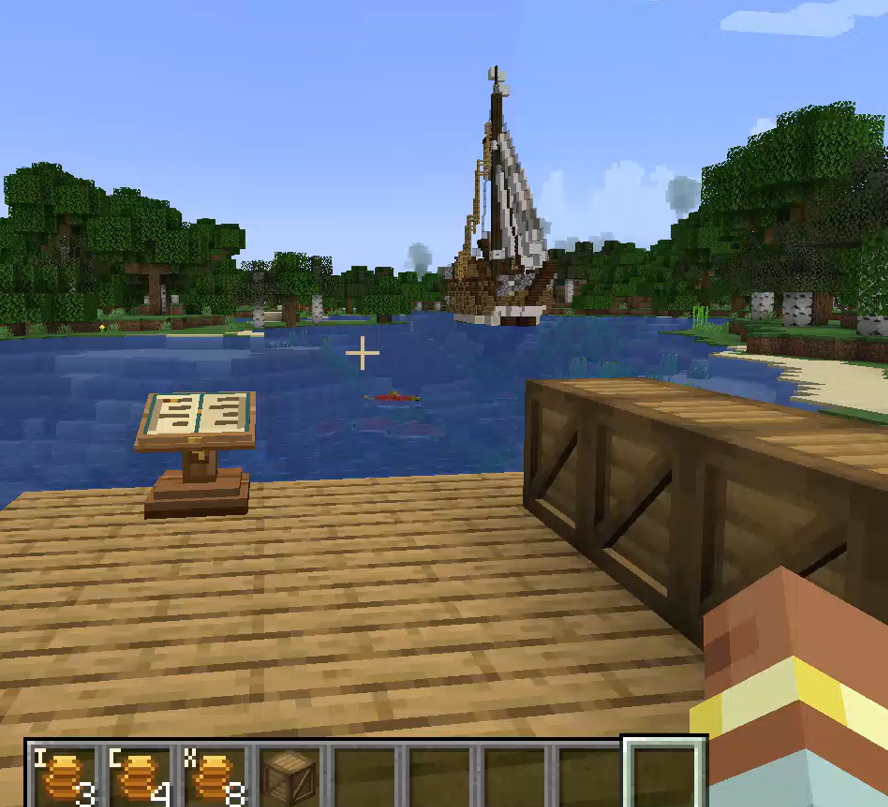
A Merchant ship approaching me during testing. In my hotbar: Gu of various amounts, and a Crate. This is in a test world, not Elysian.
These Ships come sailing. For example, if you sell goods to the Ottoman Empire, a ship will come from the Oceans, dock at your port, fill up on goods, and then head back to the Oceans. In technical terms, the ship, when trading with NPC nations, goes from and to the world border. This process (depending on where you are) takes roughly 10-30 minutes. You don’t need to supervise these ships; they drive regardless of whether their chunks are loaded in. (This is why Ocean outposts are not allowed)
These ships, however, are not perfect. They are still a lone floating vessel carrying your goods across the oceans. This is important, as technically speaking, players with ill intentions could attack and sink your ships, and if there are any goods on them, they can scavenge some of them. And this is just Elysian. The Oceans are wide and filled with other forms of danger; there is always a very small chance that your goods get taken by pirates somewhere on the oceans. I really wish that was all, but no. Your ships are also at the mercy of the elements. If, for any reason, the weather was too harsh, your boats could not leave or enter Elysian. Well, technically they can try on your command, but don’t have your hopes too high; if your goods are lost during a storm, nothing can be recovered. This is why it's extremely important to have alternative sources of income that also rely on player-to-player trading. Land trading is not affected by these trading features and can be freely managed by players.
Now let's talk about the Market. The Market is where you can sell your goods. The Market is a market with no fixed prices. To put it simply, supply and demand greatly influence the prices. You can't just pick 1 single good that sells well and farm it forever. If the supply of a good is too great, its demand will drop, and it will be worth less than it did originally. Here, it's important to diversify your production, not to rely on single sources, and to notice trends. On the market, there are also Fees and Taxes. The Merchants also need to make a living, and a Nation (both NPC and player) can direct how they do business. Most often you will see these expenses: Import tax, Trader Fee, and Transport Cost (Nation leaders can also set an Export tax). Trader Fee and Transport costs you cannot change no matter what; they are set by the Merchants.
These ships, however, are not perfect. They are still a lone floating vessel carrying your goods across the oceans. This is important, as technically speaking, players with ill intentions could attack and sink your ships, and if there are any goods on them, they can scavenge some of them. And this is just Elysian. The Oceans are wide and filled with other forms of danger; there is always a very small chance that your goods get taken by pirates somewhere on the oceans. I really wish that was all, but no. Your ships are also at the mercy of the elements. If, for any reason, the weather was too harsh, your boats could not leave or enter Elysian. Well, technically they can try on your command, but don’t have your hopes too high; if your goods are lost during a storm, nothing can be recovered. This is why it's extremely important to have alternative sources of income that also rely on player-to-player trading. Land trading is not affected by these trading features and can be freely managed by players.
Now let's talk about the Market. The Market is where you can sell your goods. The Market is a market with no fixed prices. To put it simply, supply and demand greatly influence the prices. You can't just pick 1 single good that sells well and farm it forever. If the supply of a good is too great, its demand will drop, and it will be worth less than it did originally. Here, it's important to diversify your production, not to rely on single sources, and to notice trends. On the market, there are also Fees and Taxes. The Merchants also need to make a living, and a Nation (both NPC and player) can direct how they do business. Most often you will see these expenses: Import tax, Trader Fee, and Transport Cost (Nation leaders can also set an Export tax). Trader Fee and Transport costs you cannot change no matter what; they are set by the Merchants.
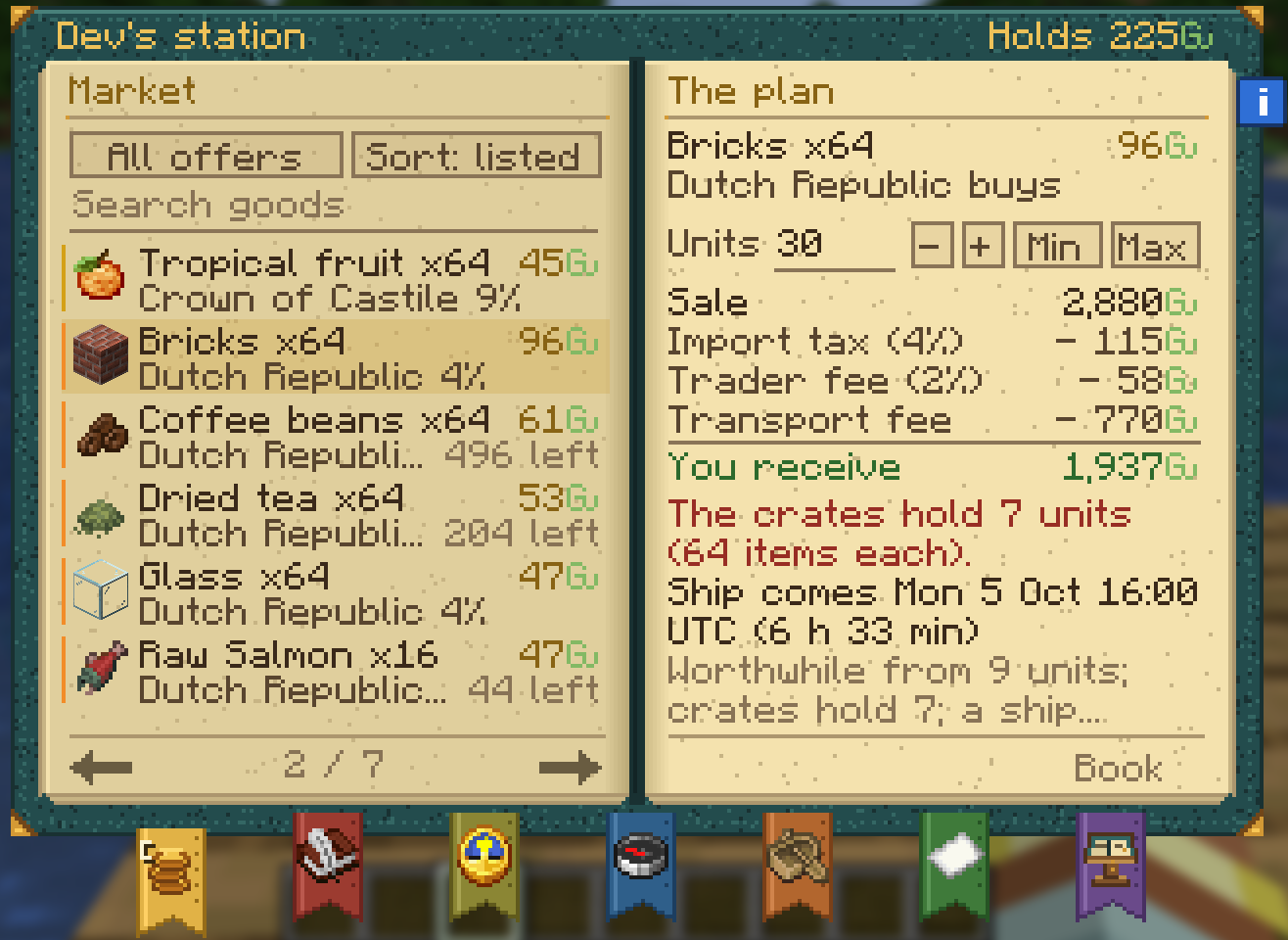
Example of setting up a trade. I'm getting a warning I only have 7 stacks of Bricks in my Crates, so I cannot book the trade.
And finally, let's talk leveling. Trading enough times does pay off. The more you trade, the more the Merchants trust you to know what you are doing. This means you can sell more goods on the Market, and larger ships will come to pick up your goods with larger storage capacity and health. More Merchant trust means lower Trader Fees; bigger ships mean more Transport costs. These depend on the ship and can overall be really worth it if you know what you are doing.
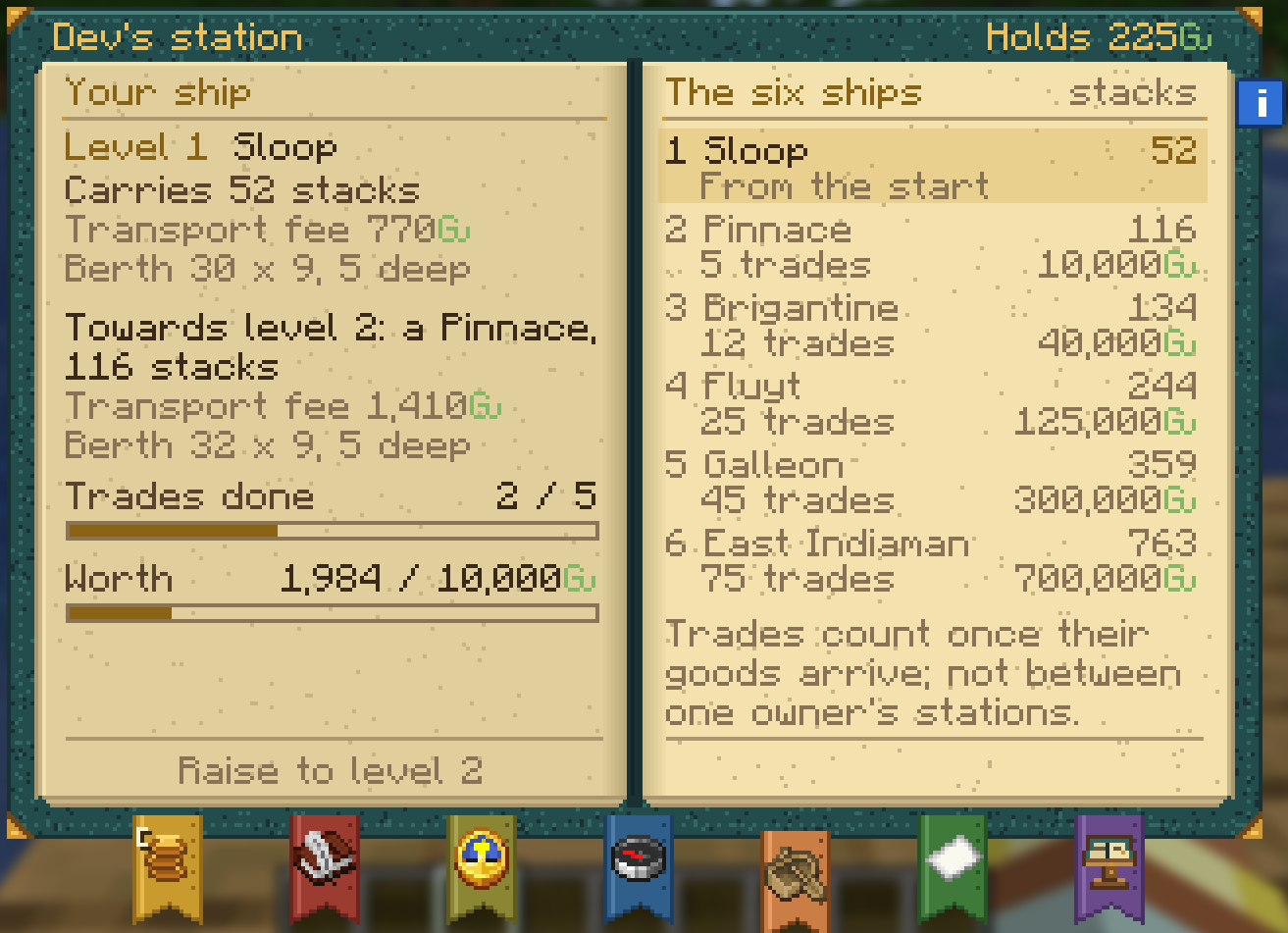
Showcase of leveling. Pretty straightforward.
Luckily, that is all. So, to summarize: Ships are realistic, trading is realistic. Ship trading can be dangerous but worth it.
If this is too much for you to do, you can always just depend on the finite supply of gold underground and take the roughly 30% conversion loss. The rough part of this is that the world may not agree forever on the value of gold. You can only make roughly 40 Gu, but who knows if that 40 Gu can consistently cover your expenses.
If you don’t want to bother with trade and money at all, we recommend becoming a citizen of a town or Nation so someone else with experience can handle it.
Thank you for reading.
-Nyseus
No comments to display
No comments to display